
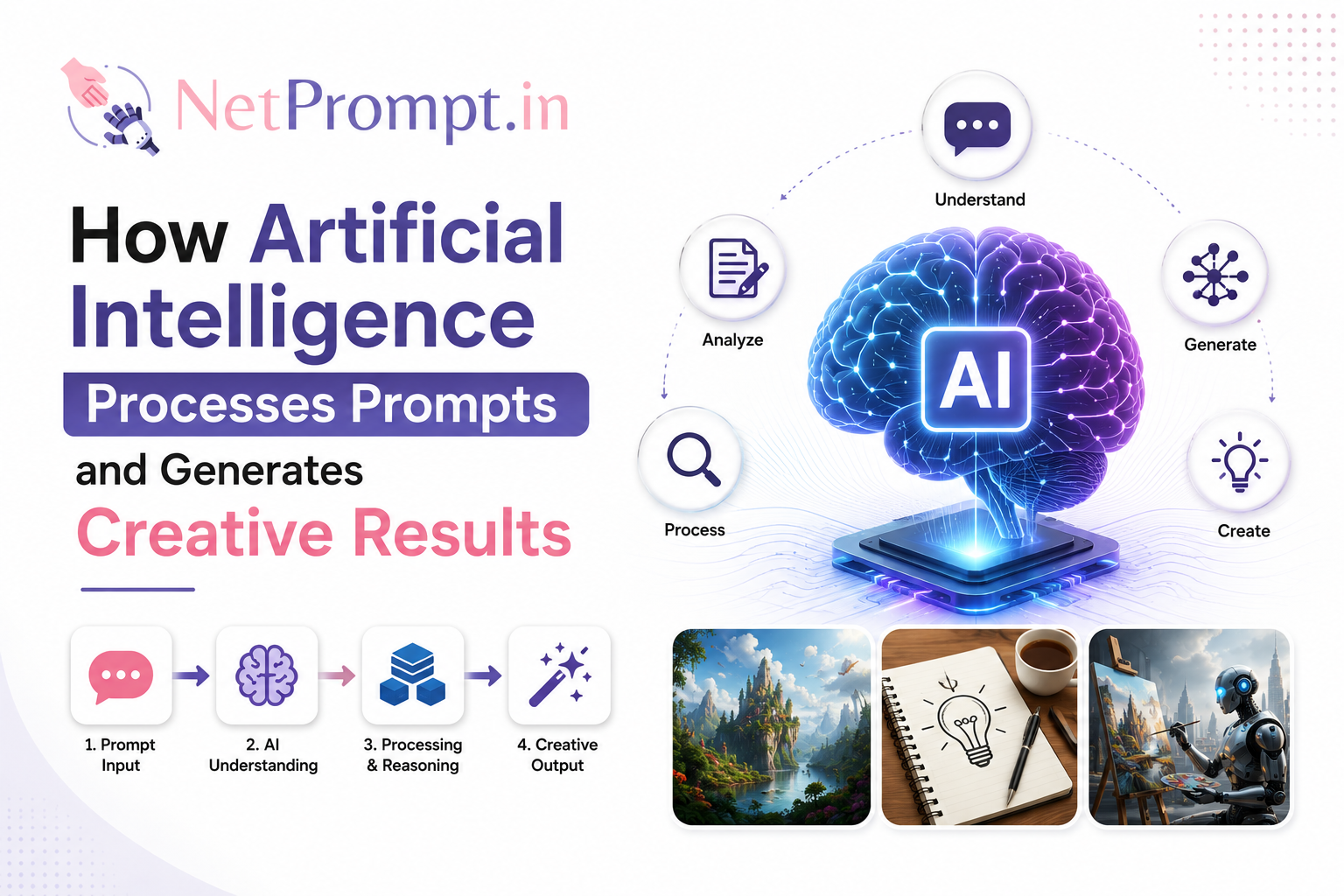
How Artificial Intelligence Processes Prompts and Generates Creative Results
In the sophisticated technological environment of 2026, understanding how artificial intelligence processes prompts and generates creative results empowers students, creators, and professionals to interact more effectively with generative models. This knowledge transforms prompting from an intuitive trial-and-error process into a deliberate, scientifically informed practice. This guide explores the underlying mechanisms of prompt processing and creative output generation in large language models such as ChatGPT, Claude, Gemini, and Grok, while providing practical insights for enhanced prompting strategies.
The Prompt Processing Pipeline
Artificial intelligence models, particularly transformer-based architectures, follow a structured sequence when handling user prompts. The process begins with tokenization, where the input text is broken down into smaller units called tokens—subwords, words, or characters—using methods such as Byte-Pair Encoding. This step converts human language into a numerical format the model can process efficiently.
Next, tokens are transformed into high-dimensional embeddings—dense vector representations that capture semantic relationships. Positional encodings are added to preserve the order and context of the input sequence. These embeddings enable the model to understand relationships between different parts of the prompt.
The core of processing occurs through the self-attention mechanism, a breakthrough introduced in the 2017 transformer architecture. Attention layers allow the model to weigh the relevance of every token to every other token dynamically. This parallel processing captures long-range dependencies, syntax, semantics, and contextual nuances far more effectively than earlier sequential models. Multiple attention heads operate simultaneously, analyzing different aspects of the input.
When a prompt is received, the model does not “understand” it in the human sense but activates relevant patterns from its extensive training data. Critical keywords and early instructions often receive stronger attention weight, explaining why strategic prompt structure significantly influences outcomes.
From Understanding to Generation: Autoregressive Prediction
After processing the prompt, the model enters the generation phase. Modern large language models primarily use an autoregressive approach, predicting one token at a time based on all previously generated tokens and the original prompt. Each prediction draws upon the model’s billions of parameters, which encode statistical patterns learned during pre-training on vast datasets.
Creativity emerges from controlled randomness in this prediction process. Parameters such as temperature adjust the diversity of outputs: lower values produce more deterministic, factual responses, while higher values encourage novel combinations and creative variations. Techniques like top-p (nucleus) sampling further refine selection by considering only the most probable token subsets.
This mechanism allows AI to synthesize ideas, reimagine concepts, and produce seemingly original content. However, it is fundamentally pattern recombination rather than genuine invention or consciousness. The model excels at interpolation and extrapolation within its training distribution but may generate plausible yet inaccurate information (hallucinations) when venturing too far from established patterns.
Factors Influencing Creative Output Quality
Several elements determine the creativity and usefulness of generated results:
- Prompt Specificity: Detailed descriptions and constraints guide the model toward targeted creativity rather than diffuse or irrelevant outputs.
- Context Window Management: Longer, well-structured prompts provide richer context but must respect token limits.
- Training and Alignment: Post-training processes such as Reinforcement Learning from Human Feedback (RLHF) refine models to follow instructions more reliably and align with human preferences for helpfulness and creativity.
- Model Architecture Variations: Different models exhibit unique strengths—some prioritize coherence, others excel at imaginative tasks.
Understanding these factors helps users craft prompts that leverage the model’s strengths while mitigating limitations.
Practical Implications for Prompt Engineering
Knowledge of AI’s internal processes directly informs more effective prompting techniques:
1. Leverage Attention Mechanisms
Place important instructions and keywords early in the prompt. Use delimiters (e.g., ###, quotes, or sections) to help the model segment and prioritize information.
2. Guide Creative Generation
Combine specific constraints with open-ended creative instructions. Example: “Act as a visionary futurist. Imagine a sustainable city in 2040, focusing on transportation and energy systems. Provide three innovative yet realistic solutions with detailed descriptions and potential challenges.”
3. Enhance Step-by-Step Reasoning
For analytical creativity, employ Chain of Thought prompting: “Think step by step, exploring multiple creative approaches before selecting and developing the most promising one.”
4. Image Generation Prompts
Multimodal models process descriptive language similarly. Layered prompts specifying subject, lighting, composition, style, and mood produce more professional creative visuals.
Example Integrated Prompt:
“You are a creative director with expertise in visual storytelling. Generate a detailed image prompt for an AI tool depicting human-AI collaboration in a futuristic workspace. Provide a rich description of the scene, characters, technology, and atmosphere. Use creative instructions to emphasize harmony, innovation, and warmth. Ensure the resulting image prompt includes composition, lighting, and technical specifications for high-quality output.”
Best Practices for Reliable Creative Results
- Iterative Refinement: Generate initial outputs, then refine through follow-up prompts that build upon conversation history.
- Balance Constraints and Freedom: Provide enough structure to maintain accuracy while allowing space for creative synthesis.
- Verification and Critical Evaluation: Always cross-check creative outputs for factual accuracy and logical consistency.
- Experiment with Parameters: Where available, adjust temperature or request multiple variants to explore creative ranges.
- Ethical Awareness: Recognize potential biases in training data and guide prompts toward inclusive, responsible creativity.
Maintaining a prompt journal to document successful patterns accelerates mastery.
Limitations and Future Outlook
While AI demonstrates impressive creative capabilities, it remains a statistical pattern-matching system without true understanding, consciousness, or lived experience. Outputs reflect the strengths and biases of training data. As models evolve—with larger context windows, improved multimodal integration, and advanced reasoning architectures—prompt engineering principles will continue adapting while core mechanisms remain relevant.
Conclusion
Understanding how artificial intelligence processes prompts and generates creative results demystifies the technology and empowers users to collaborate more effectively. By comprehending tokenization, attention mechanisms, autoregressive generation, and controlled creativity, students, creators, and professionals can craft prompts that consistently yield accurate, innovative, and valuable outputs.
This knowledge complements practical techniques such as role assignment, Chain of Thought prompting, keywords, detailed descriptions, and iterative refinement. Mastery develops through deliberate experimentation, reflection on outcomes, and ethical application.
Begin applying these insights today by analyzing and optimizing recent prompts with the mechanisms described. Consistent practice will transform AI from a mysterious tool into a predictable and powerful creative partner. In the AI-augmented world of 2026 and beyond, those who grasp these fundamentals will be best positioned to harness creativity, enhance productivity, and drive innovation across academic, professional, and artistic domains.
The intersection of human intent and artificial processing holds immense potential. Embrace informed prompting, maintain critical judgment, and unlock new levels of creative and intellectual achievement through thoughtful collaboration with artificial intelligence.


