The Complete Educational Roadmap to Become an AI Prompt Expert in 2026
In the rapidly advancing artificial intelligence ecosystem of 2026, prompt engineering has matured into a high-value professional competency. Mastery of this discipline enables individuals to extract maximum value from generative AI tools such as ChatGPT, Claude, Gemini, and Grok. This complete educational roadmap provides students, professionals, and creators with a structured, progressive pathway to become an AI prompt expert. The journey emphasizes systematic practice, iterative refinement, and ethical application, requiring no advanced technical background—only dedication and consistent effort.
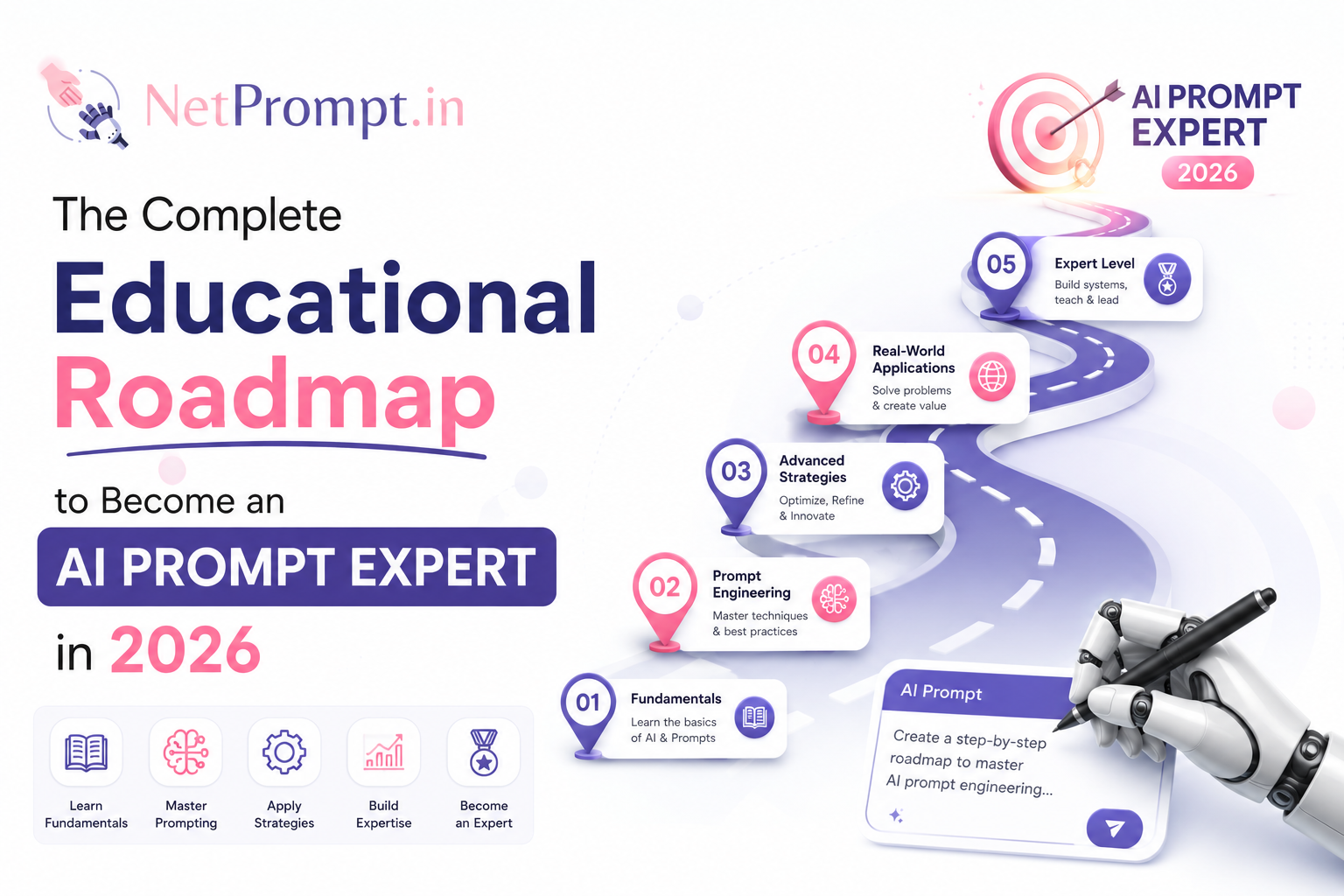
Phase 1: Building Strong Foundations (Weeks 1–2)
Establish a solid conceptual base by understanding how AI models interpret human instructions. Focus on the mechanics of tokenization, attention mechanisms, and pattern recognition without delving into complex mathematics.
Key Learning Objectives:
- Grasp the importance of clarity, specificity, and context in prompts.
- Master the three core elements: keywords (precise action verbs and domain terms), detailed descriptions (audience, tone, constraints), and creative instructions (guided originality).
Practical Activities:
- Experiment daily with basic prompts and record variations in a dedicated journal.
- Transform vague queries into structured ones. Example: Convert “Explain history” into “Act as a high school history teacher. Explain the causes and consequences of the Industrial Revolution with three real-world examples for intermediate learners.”
Dedicate 20–30 minutes daily to observation and note-taking. This phase builds intuition for prompt effectiveness.
Phase 2: Mastering Core Techniques (Weeks 3–6)
Develop proficiency in foundational prompting methods that deliver immediate improvements.
Essential Techniques:
- Role Assignment: Direct the AI to adopt expert personas for focused, authoritative responses.
- Chain of Thought (CoT) Prompting: Request step-by-step reasoning to enhance logical accuracy.
- Iterative Refinement: Treat conversations as progressive dialogues for output optimization.
- Few-Shot Prompting: Provide examples to guide format and style.
Milestone Exercise: Create 10–15 optimized prompts daily across academic, creative, and professional tasks. Compare initial and refined versions to measure progress. Incorporate structured frameworks combining role, keywords, descriptions, and output specifications.
By the end of this phase, learners should consistently generate reliable, well-structured outputs.
Phase 3: Advanced Frameworks and Optimization (Weeks 7–10)
Elevate skills through sophisticated methodologies and systematic improvement.
Advanced Frameworks:
- Integrated Keyword-Description-Creative Framework.
- Tree of Thoughts for complex problem-solving.
- Meta-Prompting: Ask the AI to refine or critique prompts themselves.
- Self-Consistency and Multi-Variant Generation.
Specialized Skills:
- Crafting high-converting prompts for content and social media.
- Developing professional AI image prompts using layered descriptive techniques (subject, lighting, composition, style, technical parameters).
- Domain-specific optimization for fashion, marketing, education, and research.
Practice Protocol: Conduct A/B testing on prompt variations, maintain a categorized prompt library, and tackle increasingly complex projects such as full campaign strategies or curriculum designs.
Phase 4: Specialization and Real-World Applications (Weeks 11–16)
Apply expertise to targeted domains while building a professional portfolio.
Specialization Paths:
- Academic/Student Focus: Essay outlines, research synthesis, and exam preparation tools.
- Content Creation: SEO-optimized articles, engaging social media, and multimedia concepts.
- Visual Design: Detailed fashion, product, and conceptual image prompts.
- Professional Use: Strategic planning, analysis, and productivity systems.
Portfolio Development: Compile 20–30 exemplary prompts with before-and-after results. Create demonstrable projects such as complete content calendars, educational modules, or visual brand assets generated through refined prompting.
Seek feedback in online communities while maintaining critical evaluation of all AI outputs.
Phase 5: Mastery, Continuous Improvement, and Leadership (Ongoing)
Achieve expert status through reflection, innovation, and knowledge sharing.
Mastery Practices:
- Experiment with emerging model capabilities and multimodal prompting.
- Develop custom frameworks for novel applications.
- Mentor others and contribute to prompt libraries or educational content.
- Stay updated with AI advancements through reputable sources.
Measurement of Expertise:
- Ability to produce consistently superior results across diverse tasks with minimal iteration.
- Efficient adaptation to new tools and requirements.
- Integration of ethical considerations into all prompting workflows.
Recommended Resources and Learning Tools
- Foundational: LearnPrompting.org, PromptingGuide.ai, and Elements of AI.
- Structured Courses: Vanderbilt University Prompt Engineering (Coursera, audit mode) and DeepLearning.AI offerings.
- Advanced: Official model documentation, research papers on prompting techniques, and specialized communities.
- Daily Tools: Maintain a digital prompt library and journaling system for tracking progress.
Allocate time weekly for resource review and experimentation.
Ethical Considerations and Responsible Expertise
True expertise encompasses responsibility:
- Verify factual accuracy against reliable sources.
- Uphold academic and professional integrity.
- Protect privacy and avoid harmful or biased outputs.
- Disclose AI assistance appropriately.
- Promote inclusive, culturally sensitive prompting practices.
Ethical mastery distinguishes competent users from true experts.
Conclusion
This complete educational roadmap charts a clear, achievable path to becoming an AI prompt expert in 2026. Through progressive phases—from foundational principles and core techniques to advanced frameworks, specialization, and lifelong mastery—dedicated learners can develop exceptional proficiency.
Success depends on consistent daily practice, systematic documentation, iterative refinement, and a growth-oriented mindset. Students gain academic excellence, bloggers and creators enhance productivity and innovation, while professionals secure a competitive edge in an AI-driven marketplace.
Begin immediately with Phase 1 activities. Commit to the structured timeline, apply the examples and frameworks provided across previous guides in this series, and track measurable improvements. The journey rewards persistence and curiosity.
As artificial intelligence continues to evolve, prompt experts who combine technical skill with ethical awareness and creative insight will thrive. Embrace this roadmap with discipline and enthusiasm. The investment in these competencies will yield substantial returns in learning efficiency, creative output, and professional opportunities throughout 2026 and beyond.