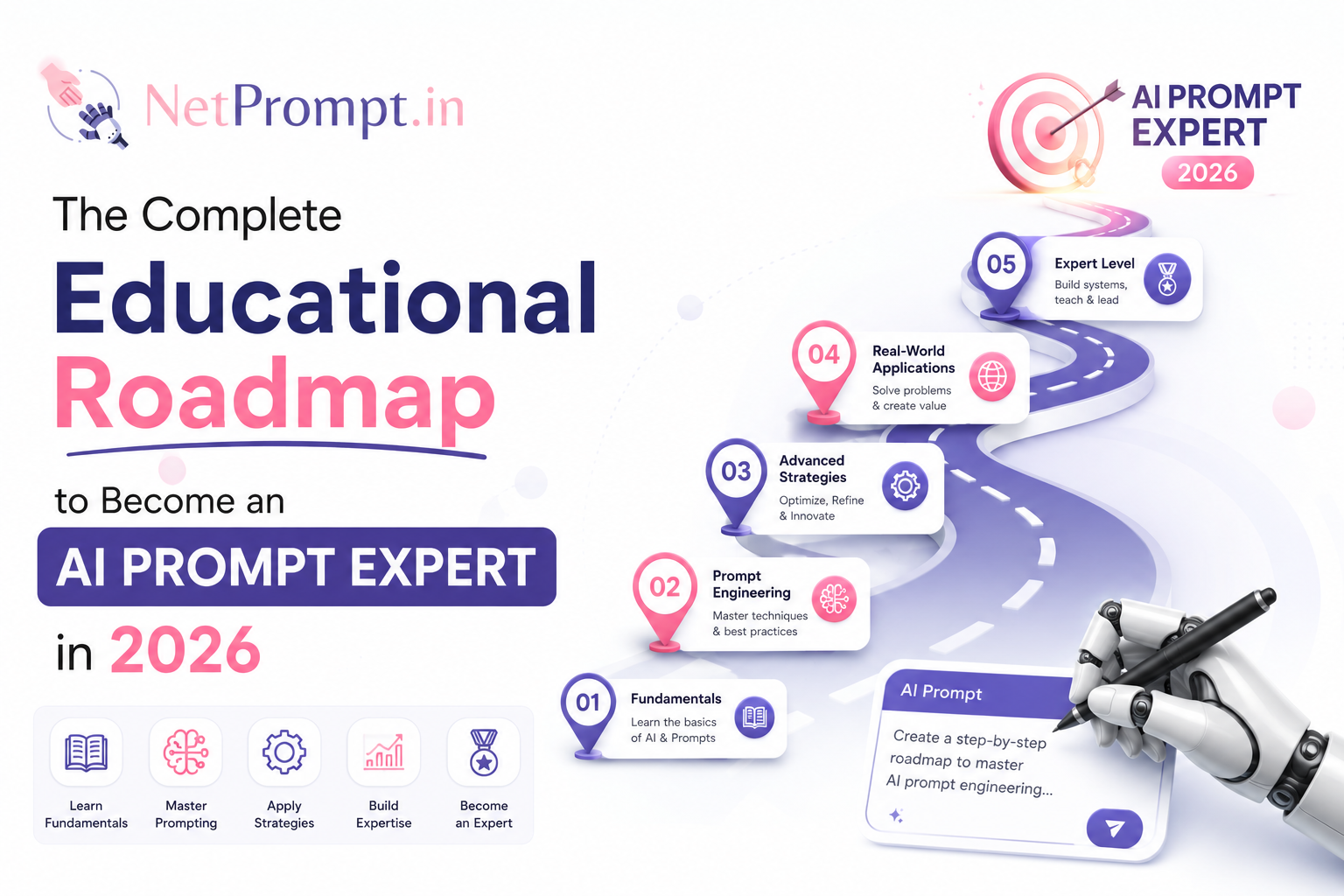
A Complete Step-by-Step Guide to Learning AI Prompt Engineering at Home
In the accessible digital environment of 2026, acquiring proficiency in AI prompt engineering no longer requires formal classroom instruction or specialized equipment. Individuals can develop this valuable skill independently at home through structured self-study, consistent practice, and free resources. This complete step-by-step guide provides students, professionals, and enthusiasts with a practical pathway to mastery, enabling effective collaboration with artificial intelligence tools such as ChatGPT, Claude, Gemini, and Grok.
Step 1: Establish a Strong Foundation
Begin by developing a clear understanding of core concepts without technical prerequisites. Prompt engineering involves crafting precise natural language instructions that guide generative AI models toward desired outputs. Models process prompts through pattern recognition, making clarity, context, and structure essential.
Actionable Home Activity:
Dedicate the first 2–3 days to experimentation. Access a free AI platform and test basic prompts. Observe how slight modifications affect results. Maintain a digital or physical notebook to record observations. Key insight: Vague inputs yield vague outputs; specific inputs produce targeted responses.
Focus on three foundational elements:
- Keywords: Precise action verbs and domain-specific terms.
- Descriptions: Audience, tone, length, and constraints.
- Creative Instructions: Guidance for originality within defined boundaries.
Step 2: Master Essential Prompting Techniques
Progress systematically through core techniques, practicing one per session.
Technique 1: Role Assignment
Instruct the AI to adopt an expert persona.
Home Practice Example: “You are an experienced history educator. Explain the key events of the Renaissance period for high school students, using clear timelines and real-world connections.”
Technique 2: Chain of Thought (CoT) Prompting
Request step-by-step reasoning.
Home Practice Example: “Think step by step. Develop a weekly meal plan for a family of four on a moderate budget, considering nutritional balance and minimal food waste.”
Technique 3: Iterative Refinement
Treat interactions as conversations and refine outputs progressively.
Technique 4: Few-Shot Prompting
Provide examples to demonstrate desired formats.
Allocate 20–30 minutes daily to deliberate practice. Rewrite everyday questions into optimized prompts and compare results.
Step 3: Build Structured Prompt Frameworks
Advance to comprehensive frameworks that integrate multiple techniques for higher-quality outputs.
Recommended Framework:
- Role or context assignment.
- Task definition with strong keywords.
- Detailed descriptions and constraints.
- Creative instructions (where applicable).
- Output format specifications.
- Evaluation or refinement request.
Full Home Practice Prompt:
“You are a professional career development coach. Analyze the most in-demand soft skills for 2026 job markets, providing a detailed description of the top five competencies for recent graduates. Use creative instructions to suggest practical home-based development exercises. Structure the response with headings, bullet points, and a self-assessment checklist. Target university students and maintain an encouraging yet realistic tone.”
Experiment with variations of this framework across different subjects to internalize its application.
Step 4: Apply Skills Across Practical Domains
Translate learning into real-world applications at home:
Academic Support: Generate study guides, practice questions, and essay outlines.
Content Creation: Develop blog posts, social media content, or marketing ideas.
Personal Productivity: Create schedules, goal-setting plans, or decision frameworks.
Creative Projects: Design image generation prompts for fashion, illustrations, or visual storytelling.
Image Prompt Example: “Generate a detailed prompt for an AI image tool: A confident young professional woman in a modern business casual outfit featuring tailored navy trousers, a crisp white blouse with subtle embroidery, and minimalist accessories. Standing in a bright home office with natural light, ergonomic furniture, and organized bookshelves. Photorealistic style, warm professional atmosphere, 16:9 aspect ratio.”
Dedicate specific practice sessions to each domain to build versatility.
Step 5: Implement a Structured Home Learning Routine
Sustainability requires consistent habits:
- Weeks 1–2: Focus on basics and daily experimentation (30 minutes).
- Weeks 3–4: Incorporate advanced techniques and frameworks.
- Ongoing: Review prompt journal weekly, perform A/B testing, and tackle increasingly complex tasks.
Set up a dedicated home workspace with quick access to AI tools and your prompt library. Track progress by noting improvements in output quality and personal confidence.
Step 6: Utilize Free Home-Accessible Resources
Leverage abundant no-cost materials:
- PromptingGuide.ai and LearnPrompting.org for techniques and templates.
- Elements of AI (University of Helsinki) for foundational concepts.
- Vanderbilt University’s Prompt Engineering course on Coursera (audit mode).
- DeepLearning.AI short courses by Andrew Ng.
- YouTube tutorials and community forums for visual demonstrations.
Schedule regular review sessions with these resources to reinforce learning.
Step 7: Address Challenges and Ensure Responsible Practice
Common home-learning obstacles include inconsistent results, motivation dips, or uncertainty in evaluation. Solutions:
- Start with simple tasks and gradually increase complexity.
- Join online communities for feedback and shared examples.
- Use meta-prompting to ask the AI for prompt improvement suggestions.
Prioritize ethical usage: verify facts, protect privacy, uphold academic integrity, and disclose AI assistance where required. Develop critical evaluation skills by cross-referencing outputs with reliable sources.
Measuring Progress and Advancing Further
Assess development through:
- Quality of outputs (relevance, accuracy, structure).
- Speed and confidence in crafting effective prompts.
- Ability to adapt frameworks to new scenarios.
Once comfortable with fundamentals, explore specialized applications such as fashion styling prompts, marketing campaigns, or technical problem-solving.
Conclusion
This complete step-by-step guide equips motivated learners with everything necessary to master AI prompt engineering at home. Through foundational understanding, systematic technique acquisition, framework application, consistent practice, and ethical awareness, individuals can achieve significant proficiency without external instruction.
The journey rewards patience and regularity. Commit to the outlined steps, maintain a reflective prompt journal, and integrate prompting into daily activities. Students and self-learners who invest in these skills will unlock enhanced learning efficiency, creativity, and productivity in an AI-integrated world.
Begin today with Step 1 activities. Dedicate consistent time, celebrate incremental improvements, and view each interaction as an opportunity for growth. Prompt engineering is a practical, evolving competency that provides lasting advantages across academic, personal, and professional pursuits. With disciplined home-based practice, mastery is both achievable and highly rewarding.